Research
How one modification controls another
Proteins are switched on, off and redirected by small chemical tags. Our lab studies arginine methylation, the enzymes that add it, and how it competes with phosphorylation, one of the cell’s main signaling switches. A second line of work asks how virtual reality can make laboratory training more equitable.
Protein arginine methylation
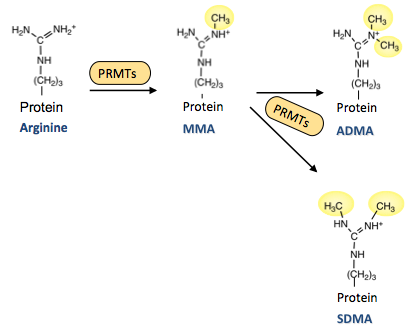
Protein arginine methyltransferases (PRMTs) attach methyl groups to arginine residues, producing three distinct products in human cells. Dr. Zurita Lopez’s doctoral work at UCLA established PRMT7 as the first true Type III methyltransferase, and she contributed to characterizing PRMT9. Methylated arginines appear on histones, p53, estrogen receptor alpha, and splicing and DNA repair proteins, and the modification is now implicated in cancer, lupus and diabetes.
Crosstalk with phosphorylation
Many kinase motifs contain arginines. When one of those arginines is methylated, phosphorylation of the neighboring serine can be blocked. Our central hypothesis is that many such motifs exist, and that mapping them reveals how cells coordinate signaling. Current work centers on histone H3, implicated in cancer, and PGC-1α, a regulator of metabolism whose methylation we found to be temperature dependent.
- Identify proteins with Akt-like motifs where phosphorylation and methylation may interact.
- Determine whether arginine methylation occurs within those motifs.
- Build an in-vitro assay for sequential crosstalk between the two modifications.
- Test whether the relationship holds in living cells.
- Determine whether the modifications act synergistically or antagonistically.

Detecting methylation as a disease marker
Changes in protein methylation can signal disease before symptoms appear. With Dr. Rigoberto Castro Beltrán at the Universidad de Guanajuato, supported by a Fulbright–COMEXUS visiting scholar award, the lab is developing microfluidic and optical methods for fluorescent detection of methylated proteins. Several current students are building histone methylation assays on microfluidic devices and rapid HPLC methods for arginine derivatives.
Other current projects
- PRMT7 substrate methylation in triple-negative breast cancer metastasis
- PRMT7 expression in muscle cells and breast cancer cells
- BAG3 and arginine methylation in alcohol-induced cardiomyopathy
- UV light and histone arginine methylation in breast cancer cells
- Expression of the tumor suppressor p53
Virtual reality and equitable lab training
Lab anxiety and limited practice time push many students, especially those from under-resourced backgrounds, out of STEM. As Co-PI on a National Science Foundation Research on Emerging Technologies for Teaching and Learning award (2023–2027), Dr. Zurita Lopez is helping build virtual-reality laboratory modules where students practice essential chemistry techniques in a low-stakes, self-paced environment. Early findings suggest VR practice reduces anxiety in general chemistry labs.
This work builds on her role as Associate Director of an HHMI Inclusive Excellence grant at Cal State LA (2018–2022), which supported institutional change in teaching practices with a focus on equitable student outcomes.
Funding
- National Science Foundation, RETTL programUsing XR to close the equity gap in laboratory training (Co-PI) · 2023–2027
- Fulbright–COMEXUS Visiting Scholar ProgramTandem micromixing technology for fluorescent detection of methylated proteins (Co-PI, host) · 2023–2024
- Chapman University, Office of ResearchInvestigating the arginine–phosphoserine interaction in histone proteins (PI) · 2023–2024
- Howard Hughes Medical InstituteInclusive Excellence grant, Cal State LA (Associate Director) · 2018–2022
- National Institutes of Health, NIGMSCrosstalk between arginine methylation and serine phosphorylation in histone H3 (SC2 award, PI) · 2016–2019
See the lab’s publications for results from this work.